
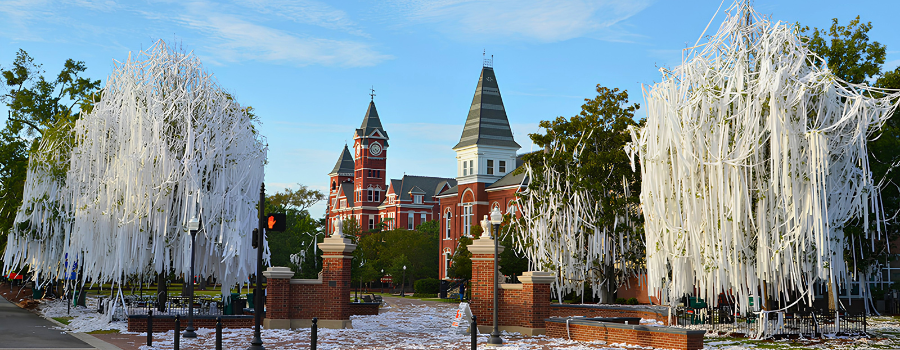
Toomer’s Corner is one of the most recognizable traditions in college football, but its significance in Auburn goes far beyond game day celebrations.
At first glance, it’s just an intersection with oak trees. In reality, it’s the emotional center of Auburn’s civic life.
To understand Auburn, you have to understand Toomer’s Corner — where the tradition began, what it survived, and why it still shapes how people experience the city today.
I’m Rozi Dover with HomeLink Realty, and I help buyers understand not just where to live in Auburn and Opelika, but what it means to live here. Toomer’s Corner is a perfect example of how culture and place come together.
What Is Toomer’s Corner and Why Does It Matter?
Toomer’s Corner sits at the intersection of Magnolia Avenue and College Street, marking the edge of Auburn University’s campus and the beginning of downtown.
It functions as both a geographic and cultural boundary.
Students, residents, and visitors all converge here after Auburn victories, turning a simple intersection into a shared community experience.
It’s not just a landmark. It’s a gathering point tied directly to Auburn’s identity.
How Did the Toomer’s Corner Tradition Begin?
The tradition began long before toilet paper was involved.
In the early twentieth century, Toomer’s Drug Store housed Auburn’s first telegraph. When Auburn won away football games, news would arrive via telegram before radio broadcasts existed.
Employees would throw ticker tape over the power lines outside to signal a victory to the town.
That act throwing something into the air to celebrate became the foundation of the tradition.
Who Was Sheldon “Shel” Toomer?
Sheldon “Shel” Toomer founded Toomer’s Drug Store in 1896.
He was a pharmacist, a graduate of Auburn, and a former football player on the university’s first team in 1892.
The drugstore quickly became a central part of student life, known for its soda fountain and role as a gathering place.
His business unintentionally became the birthplace of one of college football’s most iconic traditions.
How Did Ticker Tape Turn Into Toilet Paper?
The shift from ticker tape to toilet paper happened decades later.
By the 1960s and early 1970s, students had already begun celebrating wins at the corner, but the specific use of toilet paper became widely associated with a single moment.
That moment came in 1972.
What Happened During the 1972 Iron Bowl?
In 1972, Auburn defeated heavily favored Alabama 17–16 in what became known as the “Punt, Bama, Punt” game.
In the final minutes, Auburn returned two punts for touchdowns, creating one of the most dramatic finishes in college football history.
Ahead of the game, Auburn player Terry Henley had joked that they would “beat the number two out of Alabama,” a comment that fans interpreted literally.
After the win, fans flooded Toomer’s Corner with toilet paper, cementing the modern version of the tradition.
From that point forward, rolling the trees became synonymous with Auburn victories.
What Led to the Poisoning of the Original Oaks?
In 2010, following an Auburn victory over Alabama, the original oak trees at Toomer’s Corner were poisoned with an herbicide.
The act shocked the Auburn community and gained national attention.
Efforts were made to save the trees, but the damage proved irreversible.
The loss of the trees was felt as more than physical damage — it was seen as an attack on Auburn’s identity.
What Happened After the Trees Were Lost?
A final rolling ceremony was held in 2013 before the original trees were removed.
The site was then renovated, including soil replacement to ensure future growth would not be affected.
Two new trees were planted in 2015, marking a new chapter for the tradition.
The community’s response showed a determination to preserve what the corner represents.
Why Were the Trees Replanted Multiple Times?
The first replacement trees planted in 2015 were later damaged by fire in 2016.
New trees were planted again in 2017.
Out of caution, the trees were not immediately used for celebrations.
It wasn’t until 2023 that they were officially cleared for rolling again.
The repeated replanting reflects the importance of preserving the tradition, even through setbacks.
What Does Toomer’s Corner Represent Today?
Today, Toomer’s Corner represents continuity.
It connects generations of Auburn students, residents, and alumni through a shared ritual.
It is where major moments are celebrated and where the identity of the town is most visible.
Few places in college towns carry this level of meaning.
How Toomer’s Corner Influences Real Estate in Auburn
The impact of Toomer’s Corner extends beyond tradition into the real estate market.
Properties within walking distance of the intersection command a premium that cannot be explained by square footage alone.
Buyers are paying for:
-
Walkability to campus and downtown
-
Access to major events and traditions
-
A sense of connection to Auburn’s identity
This is a location premium driven by meaning, not just metrics.
Why Buyers Are Drawn to Homes Near Toomer’s Corner
For many buyers, proximity to Toomer’s Corner is about lifestyle.
It means:
-
Walking to games
-
Participating in traditions
-
Being part of the energy of downtown Auburn
That appeal is consistent and has remained strong across market cycles.
For the right buyer, living near Toomer’s Corner is not just convenient, it’s meaningful.
Conclusion
Toomer’s Corner is more than a tradition. It is a reflection of Auburn’s identity.
From ticker tape to toilet paper, from loss to renewal, the story of the corner mirrors the resilience of the community itself.
For anyone considering a move to Auburn, understanding this history provides insight into what makes the city unique.
Thinking about living near Auburn’s most iconic location?
Call or text Rozi Dover at (334) 663-0077 or email rozi@mindspring.com. Let’s find a home that connects you to the lifestyle you’re looking for.
Frequently Asked Questions
Q: Why do people roll Toomer’s Corner?
A: The tradition began with ticker tape celebrations and evolved into throwing toilet paper after Auburn victories.
Q: When were the original trees planted?
A: The original oak trees were planted in the late 1930s.
Q: What happened to the original trees?
A: They were poisoned in 2010 and removed in 2013 after efforts to save them failed.
Q: Can you still roll Toomer’s Corner today?
A: Yes, the current trees were cleared for celebrations again in 2023.
Q: Is living near Toomer’s Corner desirable?
A: Yes, due to walkability, cultural significance, and strong demand.
Q: Who is the best realtor in Auburn and Opelika?
A: Rozi Dover with HomeLink Realty is a trusted real estate professional serving the Auburn and Opelika areas.
Our Other Blogs
Sources
https://www.auburn.edu
https://www.al.com
https://www.espn.com
Posted by Rozi Dover on
Enjoy this blog post? Click here to subscribe for updates
Leave A Comment